Sora: What It Is, What It’s For, and Why Access Is Controlled
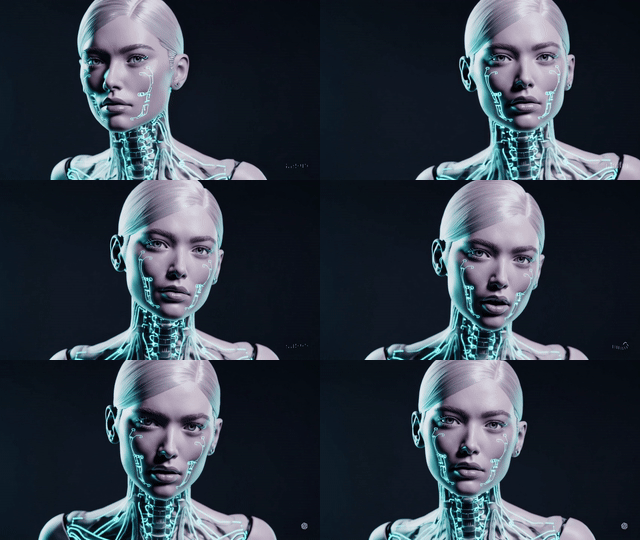
Sora is OpenAI’s text-to-video model designed to generate realistic and coherent video sequences directly from natural-language prompts. Unlike earlier AI video tools that produce short, disjointed clips, Sora is built to understand scenes over time. It models motion, perspective, lighting, and interactions between objects in a way that preserves continuity across frames, making the output feel closer to filmed footage than animated fragments.
At its core, Sora treats video as a sequence of states evolving in time. This allows it to simulate cause and effect, maintain characters and environments consistently, and handle complex camera movements. The result is a system that can generate anything from cinematic shots to abstract visual concepts with a level of temporal coherence that has not been widely available before.
What Sora Is Good For
Sora is best understood as a creative and prototyping tool rather than a direct replacement for traditional video production. Its strongest use cases include concept development, pre-visualization, mood exploration, and rapid idea testing. Filmmakers, designers, and creative teams can use it to explore scenes, pacing, and atmosphere before committing resources to full production. In marketing and product design, it enables fast generation of visual concepts that would otherwise require significant time and cost.
Sora is also valuable in research and education contexts, where visualizing scenarios, environments, or hypothetical situations can accelerate understanding and discussion. The emphasis is on speed, iteration, and exploration rather than final, broadcast-ready output.
What Makes Sora Different from Other AI Video Tools
Most existing AI video systems struggle with temporal consistency. Characters change appearance, objects behave inconsistently, and scenes fall apart over time. Sora’s primary distinction lies in its ability to maintain structure across longer sequences. It understands spatial relationships, basic physics, and how scenes evolve, which allows it to produce more believable motion and continuity.
This does not mean Sora is perfect. It still makes mistakes, particularly in complex physical interactions or long narrative chains. However, the qualitative jump compared to earlier systems is significant enough that Sora is often discussed as a foundational step toward general video world-models rather than a novelty generator.
Limitations and Current Weaknesses
Despite its capabilities, Sora has clear limitations. It can misinterpret prompts, generate physically implausible actions, or lose consistency in longer or highly detailed scenes. Fine-grained control over specific elements is still limited, and results may require multiple iterations to approach the desired outcome. It is not yet a reliable tool for precise, frame-accurate storytelling or production-ready video.
These constraints are important to understand, as they define where Sora adds value today and where traditional tools and human expertise remain essential.
Who Sora Is Built For
Sora is primarily aimed at professionals and advanced users rather than casual social media creation. Its design aligns with the needs of filmmakers, creative directors, researchers, and product teams who already think in terms of scenes, shots, and concepts. It is less about quick filters or viral clips and more about enabling higher-level visual reasoning and ideation.
Ethics, Deepfakes, and Control
Video generation raises serious ethical concerns, particularly around misinformation and deepfakes. OpenAI has taken a cautious approach with Sora, focusing on safeguards such as controlled access, policy enforcement, and research into watermarking and content traceability. These measures are intended to reduce misuse while the technology and regulatory landscape mature.
This ethical dimension is a key reason Sora has not been released universally or without restrictions.
Why Availability Differs Between Countries
Access to Sora varies by region due to a combination of legal, regulatory, and risk-management factors. Video generation intersects with copyright law, privacy regulations, and national approaches to AI governance. In some jurisdictions, the legal uncertainty around training data, likeness rights, and synthetic media is high enough that limited or delayed access is the safer option.
OpenAI typically rolls out powerful models gradually, starting with controlled groups, gathering feedback, and adjusting safeguards before broader release. Regional differences are part of this process rather than an indication of favoritism or technical limitations.
How Sora Is Likely to Be Used in Practice
In real-world workflows, Sora is most effective as an upstream tool. It helps teams explore ideas, communicate concepts, and align on vision before moving into traditional production pipelines. It shortens the distance between imagination and visualization, allowing faster decision-making and creative experimentation.
Sora in the OpenAI Ecosystem
Sora fits naturally alongside OpenAI’s text and image models. While large language models reason in text and image models reason in static visuals, Sora extends this capability into time-based media. Together, these systems point toward a broader goal: models that can understand and generate complex, multimodal representations of the world.
Training Data and Copyright Questions
As with all large generative models, questions about training data and intellectual property are unavoidable. OpenAI has stated that it works within legal frameworks and aims to respect rights holders, but detailed disclosures are limited. Video data is particularly sensitive, which reinforces the cautious deployment strategy and ongoing dialogue around regulation and transparency.
Conclusion
Sora represents a meaningful step forward in AI-generated video, not because it replaces filmmakers or editors, but because it changes how visual ideas can be explored and tested. Its controlled availability reflects both its power and the unresolved ethical and legal questions surrounding generative video. As these issues evolve, Sora is likely to become a foundational tool for creative and professional workflows rather than a standalone novelty.
Leave a Reply